
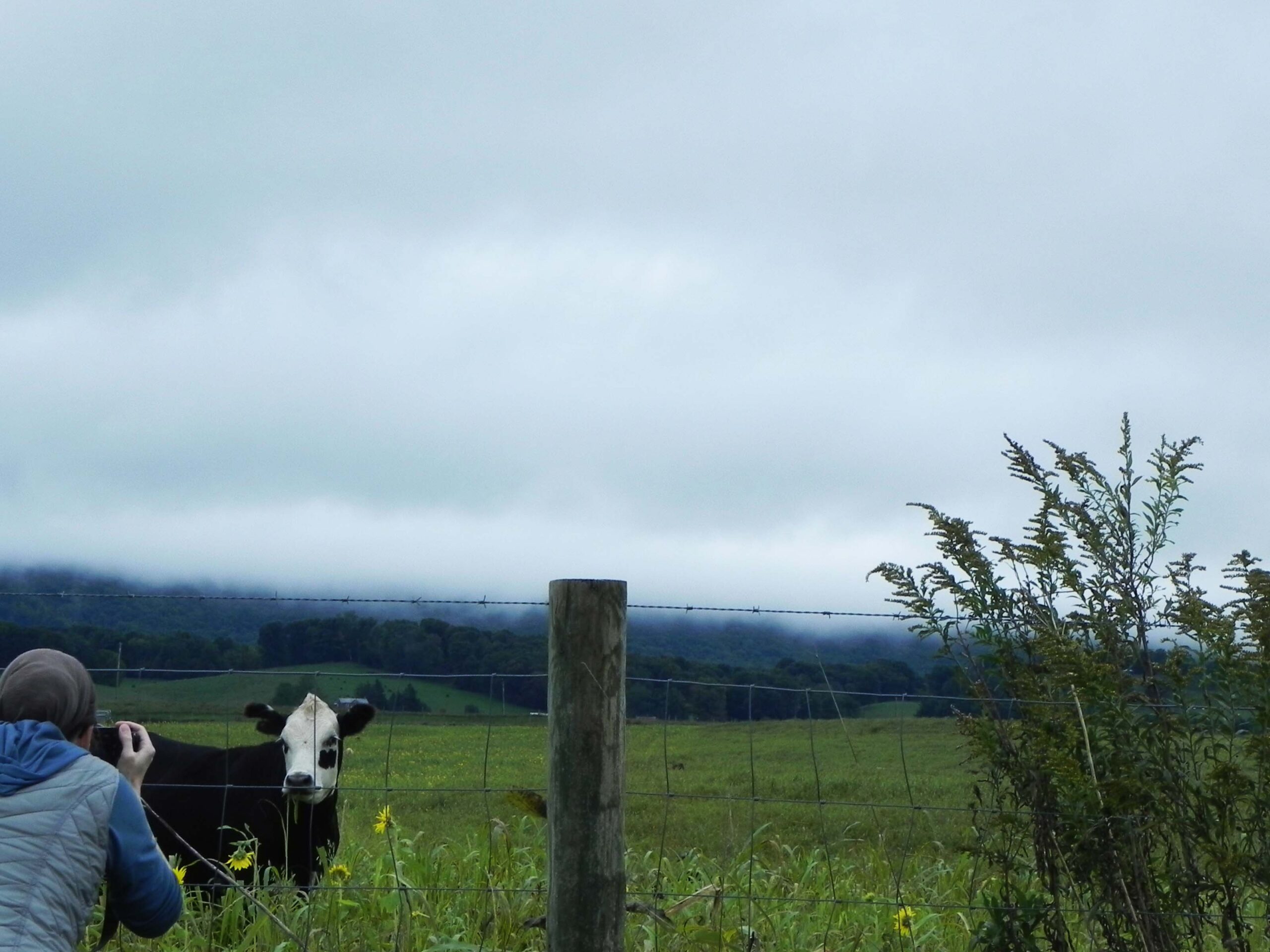
Recently, I took a few days off of work and Mom and I went on a road trip a few hours south. We’ve never done a mother-daughter trip before, but just wanted a leisurely vacation without too much driving and plenty of time to sleep in. We packed most of our food— a great way to save time as well as money especially if you’re visiting an area with as many state parks as West Virginia.

Monticello
Neither of us had ever visited Thomas Jefferson’s historical home in Virginia before. We toured the inside of the mansion and walked around the grounds a bit, although it was raining on the day we were there so we didn’t spend much time outside.
In school, one of my teachers loved visiting presidents’ home, and as our tour guide told us bits about Jefferson’s life, memories of Miss Birk’s classroom came back. She must have visited Monticello.
You can look at Thomas Jefferson in two ways: the brilliant writer of the Declaration of Independence or a man who enslaved over six hundred people. He was, of course, both.
Our guide told us that while Jefferson inherited a huge plantation, he died nearly $100,000 in debt.


Burke’s Garden
Burke’s Garden is a remote valley, nicknamed “God’s Thumbprint”, filled with beautiful farms. We stopped at one Amish store, but we were mostly there to enjoy the scenery. Mountains completely wrap around the valley.

From the valley, we took a rough gravel road up the mountain to a spot where the Appalachian Trail went through.


Trans-Allegheny Lunatic Asylum
It’s the world’s second-largest hand-cut stone building, exceeded in size only by the Kremlin. And it was built to house the mentally ill in West Virginia in the 1850s.
In one of the museum’s rooms, there a list of “Reason for Admission” taken from official 1800s records. The list includes “political excitement”, “jealousy”, “novel reading”, “parents were cousins”, “business trouble”, and many more.
Despite the sketchy reasons for admission (it was a different world, our tour guide said) it seems that at first, Trans-Allegheny wasn’t a terrible place to live. The founders believed beautiful surroundings would benefit the mentally ill, hence the elaborate architecture.
Over the years, the institution declined. The building was designed for 250 residents, but by the 1950s, it housed over 2,000. During that era, horrors like lobotomies also flourished. In the 1990s, the asylum, which had changed its name to “mental hospital”, finally closed its doors and re-opened as a tourist attraction about twenty years ago.
I wouldn’t take children to visit, but most adults would find it a fascinating look at the ways institutional care can go badly wrong.


New River Bridge and Blackwater Falls
We crossed over the New River bridge, the largest arch bridge in the Western Hemisphere, and then stopped at a state park with an overlook of the bridge.
We saw Blackwater Falls on the same day. Found both the same way, suggestions from Google maps for “sights along the ways”. Great way to do a leisurely road trip!
I don’t have pictures but driving in West Virginia was some of the prettiest driving I have ever done. The Appalachian Mountains aren’t the Rockies but they are beautiful and for us, a whole lot closer.


Places We Stayed
We stayed in four different places, but the Old Jail motel was the nicest, especially since we were the only occupants.
Despite its history as Tazewell’s jailhouse, the Old Jail today looks just like any other old house. We slept in a former cell and it was a nice clean room with handmade quilts on the bed and its own bathroom. No bars on the windows or anything like that.

We also stayed in a couple of Airbnb’s described as “tiny houses”. Clever marketing. They should be called “flipped sheds”.
Pictured above is the first place we stayed, in the woods far from any other buildings. Outside it was pouring buckets. If we turned on the heater, the lights dimmed. The door didn’t lock, so we propped a chair in front.
I was sleeping in the loft. Mom was trying to sleep, but feeling nervous about the door. She saw a Bible laying on the nightstand and opened it. Inside there was a sticky note with the word “DEATH” in big letters, nothing else. That didn’t help her feel better.
A note from a Bible study or a sick joke? We’ll never know which, but we threw the note out and survived the night.

Harper’s Ferry
On the last day of our trip, we drove to Harper’s Ferry. We lucked out when we discovered that a park ranger was giving a lecture on the history of the town.
Most of us associate Harper’s Ferry with John Brown, but there was more history there than just that. One thing the ranger said really interested me: the armory at Harper’s Ferry was among the first places where the concept of interchangeable parts was put to test in a factory. Until then, every gun had been unique. So the armory at Harper’s Ferry help lead to the Industrial Revolution and the fact that I could order a new knob for our dryer a few weeks ago with only a model number.

After we left Harper’s Ferry and headed north, we passed by towns like Sharpsburg and Gettysburg, where some of the biggest battles of the Civil War took place. We drove through York, which was the northernmost town that Conference army seized.
From York County, we drove over the Route 30 bridge into Lancaster. In the river, we could see the piers of the bridge that Union troops burned to keep the Conferences from crossing the river. If the bridge hadn’t been burned, Lancaster might have fallen. From there, Lee’s army would have marched to Philadelphia… and, well, America and the world could be a different place.
We’d seen lots of pretty scenery and had a restful time. But yes, the tour had been a little morbid. Slavery, war, an asylum, even a jail… As we drove, I asked Mom, “How would you rank those four on a scale of bad to worse?”
We both agreed war would be the worst, but differed on how we’d order the others.
History reminds us that suffering, in matters small and great, is part of living in this world…waiting for morning.
“Political excitement?” You could institutionalize a lot of people with that reason!
In 2020, EVERYONE would have been committed.
Good read . I would enjoy visiting Burke’s Garden and Asylum . Just thinking about the asylum makes me sad for the people that had to live there.
Yes, it was a place of heartbreaking stories… Burke’s Garden was only a few hours away, and such a pretty place.